This is what I call a smart tag!

[No RFID was hurt during the shooting of this photography]

 Firefox 7 is out, available as usual in all flavours (Win, Mac OS…).
This year Firefox, and the Mozilla guys, have been working quite hard pulling off so many software releases.
The latest version of Firefox has the following changes:
I’m a long-time Firefox addict and usually welcome any new release but, please Mozilla, take a breath until you give us Firefox 8!
By the way, has anyone appreciated the Firefox 6 (yes, still fiddling with that) Scratchpad?
The new Scratchpad tool makes it simple to quickly enter, execute, test and refine JavaScript snippets in Firefox without needing to work in a one-line console.
 Ok, this may seems as the most auto-referential Google Doodle of it all, but Google today celebrates its 13th birthday!
It’s been a long long time: I’m old enough to remember Altavista, Lycos, Alltheweb, Ask and a lot more.
Today, Google is much more a global economy phenomenon than just a search engine.
AdWords (and AdSense), its many highs (and some lows – Orkut anyone?) are now a significant part of the global business – and everyday life, given the billions of search results served each day to users everywhere in the world.
What thrills me is what Wired reported, the Sept 7th, 1998 check that turned Brin&Page into Google inc.: a mere $ 100,000 that now means billions.
That’s business!
😉
 The tablet wars looked already won by iPad alone, until now.
A new player may be entering the tablet arena pretty soon.
NY Times reports that Amazon may be releasing its tablet just in time for Christmas.
Predictions (or rumors) include a $250 price tag (half an iPad), seven inches screen – a touch-screen, unlike the current Kindle (actually a best-seller).
An analyst, as reported by NYT, says that “Whichever company triumphs, [said the Barclays analyst Anthony DiClemente] the consumer is going to be the winner.”
Will the real anti-iPad please stand up?
Until that day, I hold on to my iPad 2 and keep on using one of the most surprising device ever…
More details here on NY Times
 Remember Sesame Street?
Today’s Google Doodle celebrates Jim Henson birthday with an animated doodle.
Beware that one puppet is going to eat another – you decide who to keep…
Thanks Jim!
Robert Scoble reported that Google may be developing a Flipboard-alike – a popular social media browsing app.
Propeller is te more likely name for this app aimed at Facebook, Flipboard (maybe the rest of the world) and running both on iOS and Android.
[Via Scoble on Google+ and AllthingsD]
A Nielsen report released Monday found out that Americans spend almost a quarter of their time online on social networking sites, and counting…
According to the report — which combines data from Nielsen mobile and online meters, buzz data and a survey — Internet users spend more than twice as much time on social networks (including blogs) as they do on online games, the next top web destination by time.
Some key findings include:
The most popular social network as measured by Nielsen online meters is Facebook, followed by Blogger, Tumblr, Twitter and LinkedIn.

Nine of the 10 most popular social networks were dominated by women. Only LinkedIn had a percentage of men visiting the site that exceeds the percentage of men who are active Internet users. Women also watch more video content than men, although men watch longer videos.

[Via NielsenWire]
 According to a white paper study from IDC there will be 1800 exabytes (EB) of digital data in 2011, up from 220 EB in 2007. Such growth places the data user under tremendous pressure to turn data into actionable insights quickly, while straining the world’s IT infrastructure to its limits. This forces the data user to manage the explosive growth of data and storage using tools designed for easier times.
Smashing all known records by a multiple of 10, IBM Research Almaden, California, has developed hardware and software technologies that will allow it to strap together 200,000 hard drives to create a single storage cluster of 120 petabytes — or 120 million gigabytes.
The giant data container is expected to store around one trillion files and should provide the space needed to allow more powerful simulations of complex systems, like those used to model weather and climate.
A 120 petabyte drive could hold 24 billion typical five-megabyte MP3 files or comfortably swallow 60 copies of the biggest backup of the Web, the 150 billion pages that make up the Internet Archive’s WayBack Machine.
120PB is the kind of capacity that you need to store global weather models or infinitely detailed weapon system simulations, both of which are usually carried out by government agencies or federally-funded research institutions. Alternatively, it could be used to store a large portion of the internet (or data about its users) for Google or Facebook, or another client with very deep pockets.
The largest systems currently in existence are generally around 15 petabytes — though, as of 2010, Facebook had a 21PB Hadoop cluster, and by now it’s probably significantly larger.
Exact details about the software and hardware isn’t given by IBM, but we do know that it features a new-and-updated version of IBM’s General Parallel File System (GPFS).
GPFS is a volume-spanning file system which stores individual files across multiple disks — in other words, instead of reading a multi-terabyte high-resolution model at 100MB/sec from a single drive, the same file can be read in a massively parallel fashion from multiple disks.
The end result is read/write speeds in the region of several terabytes per second — and, as a corollary, the ability to create more than 30,000 files per second.
GPFS also supports redundancy and fault tolerance: when a drive dies, its contents are rebuilt on a replacement drive automatically by the governing computer.
GPFS has been already breaking world records by itself scoring a 37x record in file scanning (see GPFS breaks file scanning record by 37x) which means that brutal hard disk workforce is nothing if not paired with innovative software.
On the hard drive side of things, if we divide 120PB by 200,000 you get 630GB — and once you factor in redundancy, it’s fairly safe to assume that the drives are all 1TB in size. We also know that every single one of the 200,000 drives will be watercooled with presumably the largest and most complicated bit of plumbing ever attempted — but considering IBM’s penchant for watercooling its top-end servers, that’s hardly surprising (though we still hope to post a photo of the system once it’s complete).
Swedish group Rymdreglage (AKA Ninja Moped) has released a stunning video that’s both a tribute to 8-bit videogames – namely NES – and Lego stop-motion technique masterpiece.
They did it in just 1,500 hours using tons of lego, patience and… a Canon 7D digital camera, remotely controlled by a notebook.
Their achievement is quite unique considering the low-budget and that’s a two-men crew.
Here’s the video, check all the NES and the 80’s retro-gaming cameos!
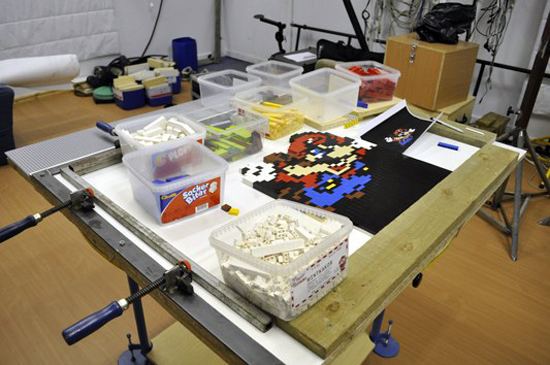
And here, on DesignBoom, you can find some great pictures explaining the work in progress, how many paper/Lego templates were employed.
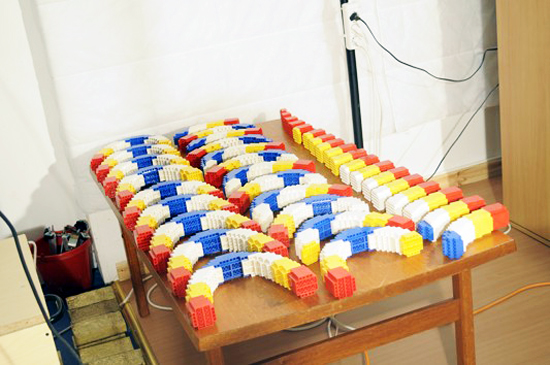
Check here how many coloured arches were made with tiny differences:
Rymdreglage were kind enough to share with us the inner secrets of making something so weird, yet so technically challenging: check their 3-part making tutorial!
You can even buy the song on iTunes or just check the weirdo Rymdreglage web site – and take a look at some other works of the group!
Why am I so turned on by Lego stop-motion?
I made my own video back in 1980 (I was 13 years old…) with a Super 8 Canon film camera along with a shutter cable I’m still using.
Wanna see?
Note: no Lego was apparently hurt during the video shooting.
[Via Wired and Designboom]
Ikea UK has launched a new Youtube video along some Facebook interaction.
Ikea in the UK has created a Facebook-enabled experience on its interactive YouTube channel that ties into the brand’s larger “Everything You Need To Go Happy To Bed” campaign. It works like this. Users are asked to show how many people are in the room with them, then a personalized room furnished with Ikea products is shown that includes framed pictures from the participant’s Facebook profile. As the video plays, the viewer is told a story. Meanwhile the user can customize the items in the video and purchase them at the end.
The real fun is on their YouTube channel, where they’ve extended the idea with Facebook Connect.
It starts with a room being built from comments on your wall, before flying you through a rendered 3D room incorporating your personal photos. While it voice overs a great little story, you have the option to click and add every item you see to a temporary shopping cart.
Check this pillow-fight…
Nice idea!
[Via Digitalbuzz]
